
written by:
Ornatus Mundi
published:
2026-05-12
categories:
Breguet, collectors, George Daniels, Richard Daners, Thomas Engel, watches
An intimate moment with a rare pocket tourbillon made by ‘modern Thomas Edison’, Thomas Engel
The watch, with 1-minute flying tourbillon carrying a 0.2sec remontoir in its cage, was what Engel himself said ‘his last watch’ since ‘he could not improve further’ (until he changed his mind…)
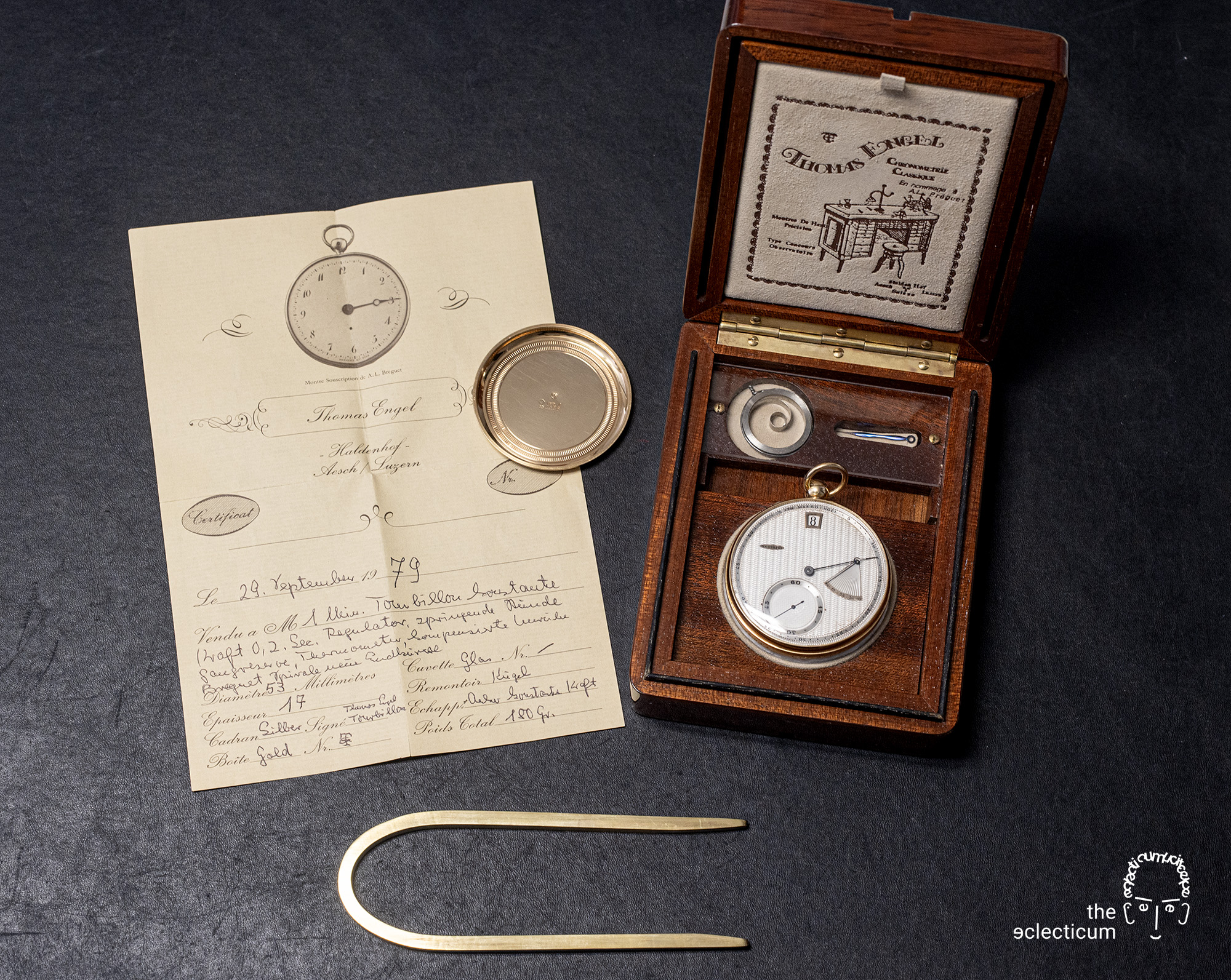
There are those ‘grail pieces’ in watchmaking that, by virtue of their excellence, the personality of their maker(s) or the mystique around their creation carry this fatal attraction of an object where every aspect just ‘clicks’. In my book, pieces from George Daniels, David Walter or Christian Klings feature here. Or one of the rare watches of Thomas Engel, where all the above qualities are abundant.
Thomas Engel (1927-2015)
Thomas Engel represents the dream of ascending from ‘rags to riches’, German style. His father passed away when he was a little child, bringing the presence of a constant struggle to survive to the family. His education was cut short when he was drafted into the military of the Third Reich. This and the post-war experience of poverty imprinted a quest for ‘self-reliance’ deeply into the mindset of a young Engel.
His wealth came from polymer chemistry, a discipline he taught himself in long nights of reading each book on the topic he could get hold of. This self-study yielded over a hundred of patents he licenced profitably to multinational companies (some of them offered considerable sums to convince him joining them fulltime which he always declined). To give a scale to his achievements, Engel received the prestigious Rudolf-Diesel-Prize together with Dr. Wernher von Braun.
During a business trip to London, he bought what he thought was a ‘Breguet’ pocket watch. At the same trip, he was introduced to Cyril Rosedale, and English Gentleman and Breguet collector of sophistication who immediately identified this watch as a fake. That evening, Engel and Rosedale sat down at the latter’s estate allowing Engel to appreciate for the first time an eclectic selection of Breguet watches, their refinement in style and execution, and the existence of a vast amount of literature to back up their history.
Engel learned that night that meaningful watch collecting required the same ‘studiosus’ mindset he applied for his polymer studies. And that was the beginning of another chapter…
What followed was his rise to an eminent Breguet collector and author, and he forged friendships with the then most important figures in watch making and collecting scene (including Alfred Hellwig and (ambiguously) George Daniels), with many stunning anecdotes which are well documented in the listed literature, so I am not repeating them here.
In the course of his collecting journey, he became acquainted with watchmaker Richard Daners (1930-2018) from Gübelin in Lucerne. Daners accepted him as a student, and together they embarked on a collaboration which yielded about 40 pocket watches in the style of Abraham Louis Breguet, based on Zenith chronometer movements and made in two categories, Concours Observatoire watches (based on Zenith Cal. 5011K, believed 9 made) and Tourbillons (based on Zenith Cal. 5011T, believed 19 made). Note that Zenith agreed to provide those movements in bespoke configuration to Engel/Daners.
The collaboration was structured such that Daners would create the tourbillon, while Engel would be responsible for the rest of the movement, dial and case.
Engel recalls:
“Es dauerte nur etwas mehr als ein Jahr, bis das erste Tourbillon tickte. Was für eine Freude! Herm Daners ließ es ziemlich kalt. Für mich als Laie war es aber ein unvergesslicher Augenblick in meinem Leben. Ich war mächtig stolz.” (Thomas Engel, Ein moderner Thomas Edison, p.203)
(‚It took a little over a year until the first Tourbillon ticked. What a joy! It left Mr. Daners quite cold. But for me, as a layman, it was an unforgettable moment in my life. I was tremendously proud.’)
Engel and his wife spend significant amounts of time and effort into mastering the art of guillochage, a dial finishing technique which Breguet made famous.
True to his scholarly approach to collecting Breguet watches, Thomas Engel meticulously documented his own made watches. Sadly, much of the papers were lost due to a burglary at his house.
Thomas Engel’s Flying Tourbillon with Remontoir and Jumping Hours (1979)
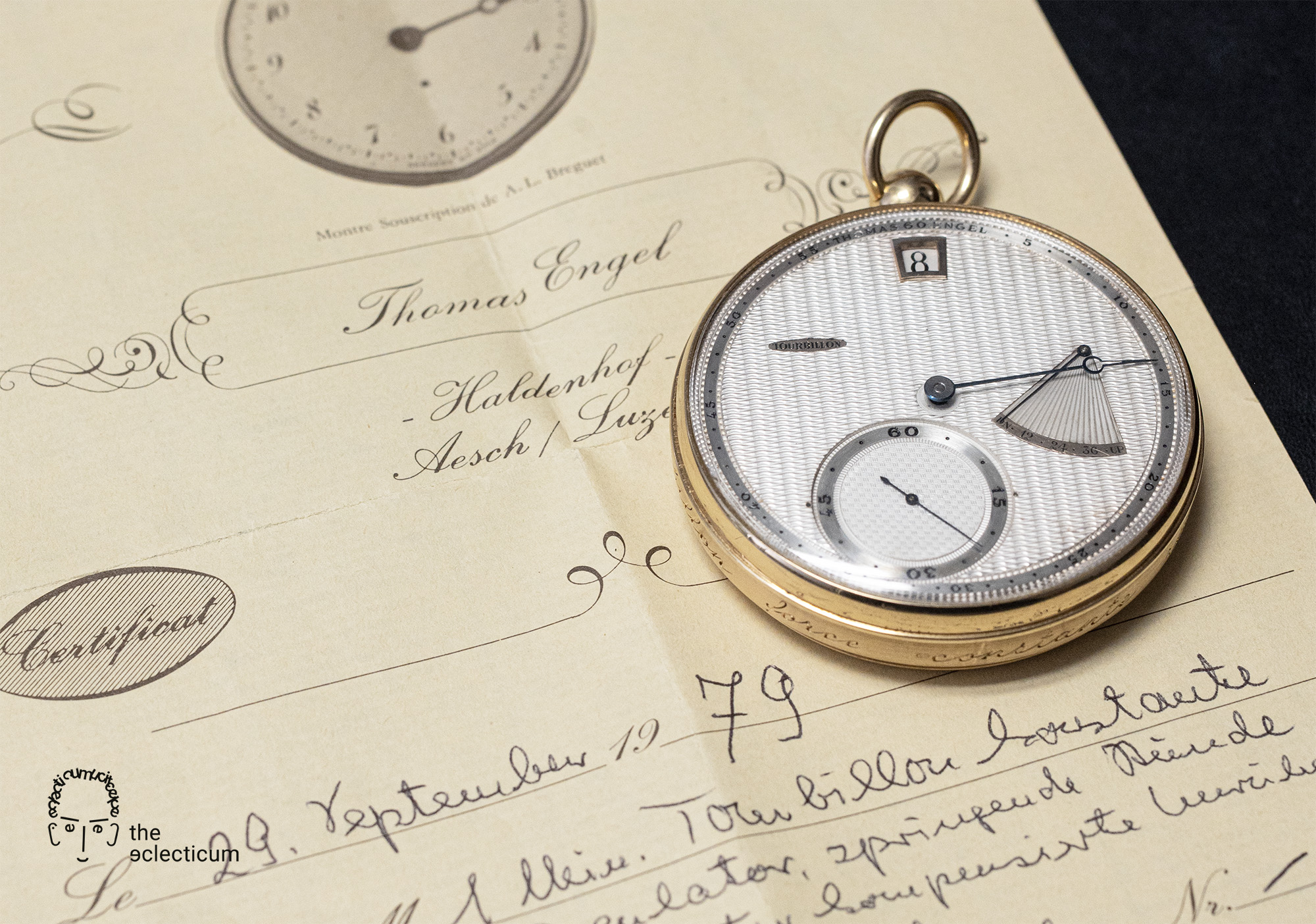
For its May 2026 watches auction, Vienna auction house Dorotheum lists this Thomas Engel pocket watch which immediately drew my attention – let’s start with the technical data, taken from the accompanying certificate:
- Escapement: Swiss lever, 1min flying tourbillon, 0.2sec remontoir, integrated into the tourbillon cage
- Complications: regulator, jumping hours, power reserve, (thermometer)
- Winding/setting: via the pendant
- Dimensions: 53mm ∅ (note: this must be the movement only), 17mm height
- Case: 18kt. gold
- Dial: hand-guilloché silver dial with applied plates
- Hands: heat-blued stainless steel
- Date of Completion: 29.09.1979
A masterpiece of artisanal watchmaking
Holding a watch of the making of Thomas Engel’s pieces in one’s hand for the first time gives an instant recognition of ‘hand-made excellence’ – of the kind that one realises without exactly knowing how and why. The piece exudes the aura of an extremely fine human artefact which is matched by only very few contemporary watches today (even from the most revered independent watchmakers).
That fact that it is a pocket watch certainly plays a part. That it carries regulator dial layout even more so.
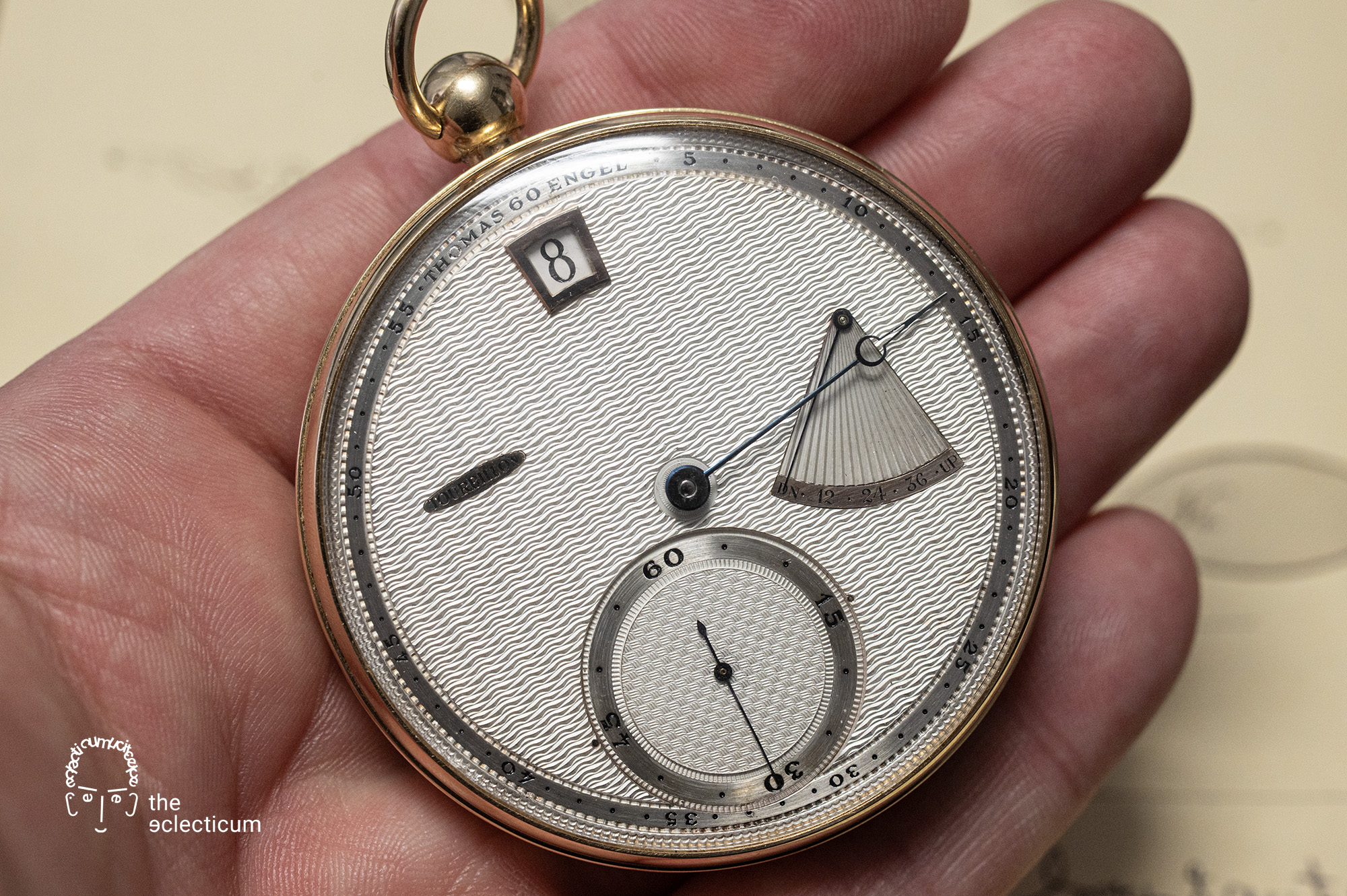
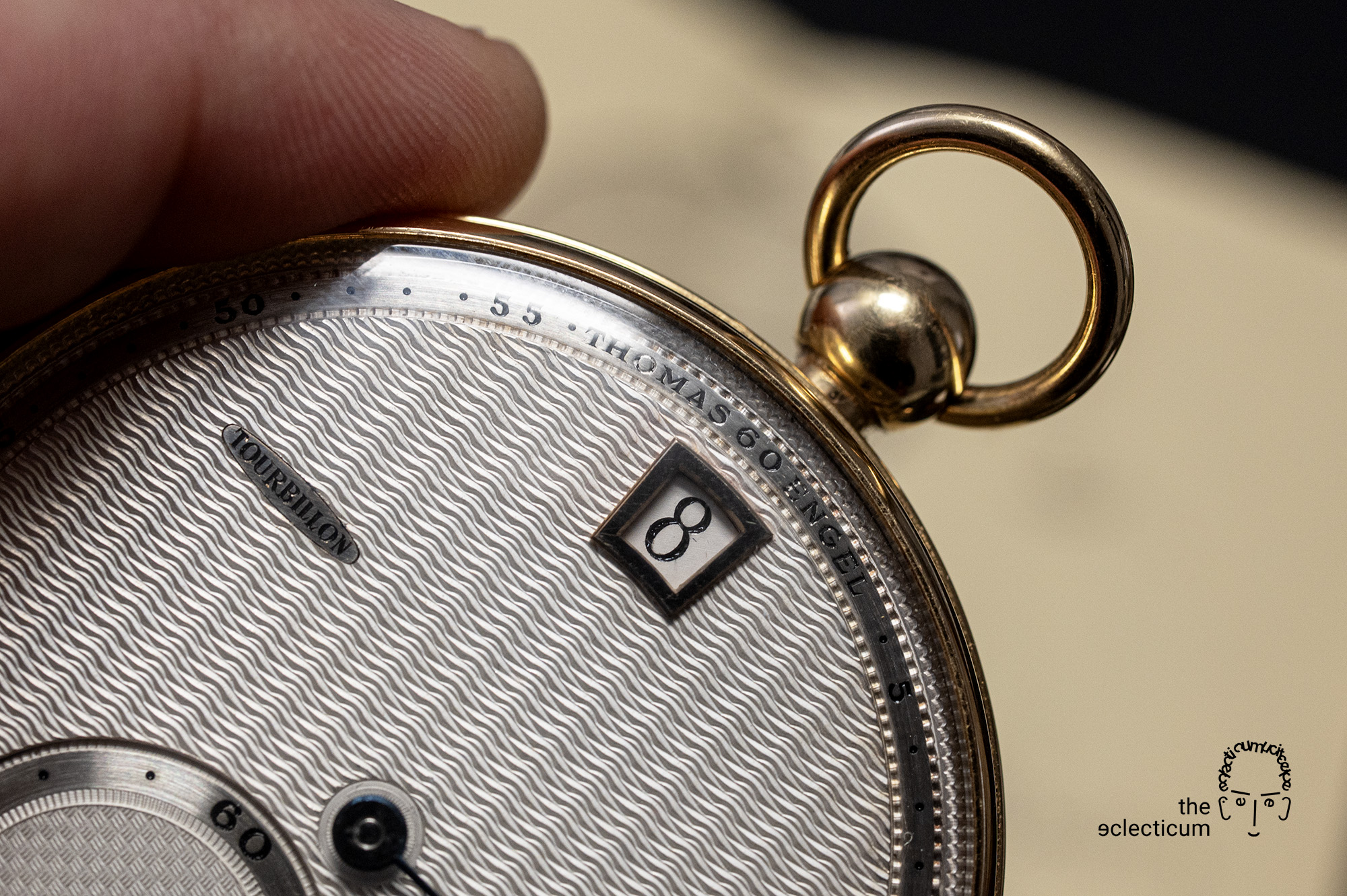
This vast dial area, a true showcase for finest engine turning work!
First, there is the asymmetric placement of the elements. Clearly not by chance, as Engel understood and appreciated Breguet’s approach to design (which placed mechanics first and then made the dial work) well enough to emulate it as well:
- 12 o’clock: jumping hours window
- 2:30: power reserve indication
- 6:20: seconds dial
- 9:45: tourbillon plaquette
The regulator dial leaves more surface uncovered by hands than a normal dial arrangement – place which Engel used to fill with his excellent guilloche work (which he actually created together with his wife):
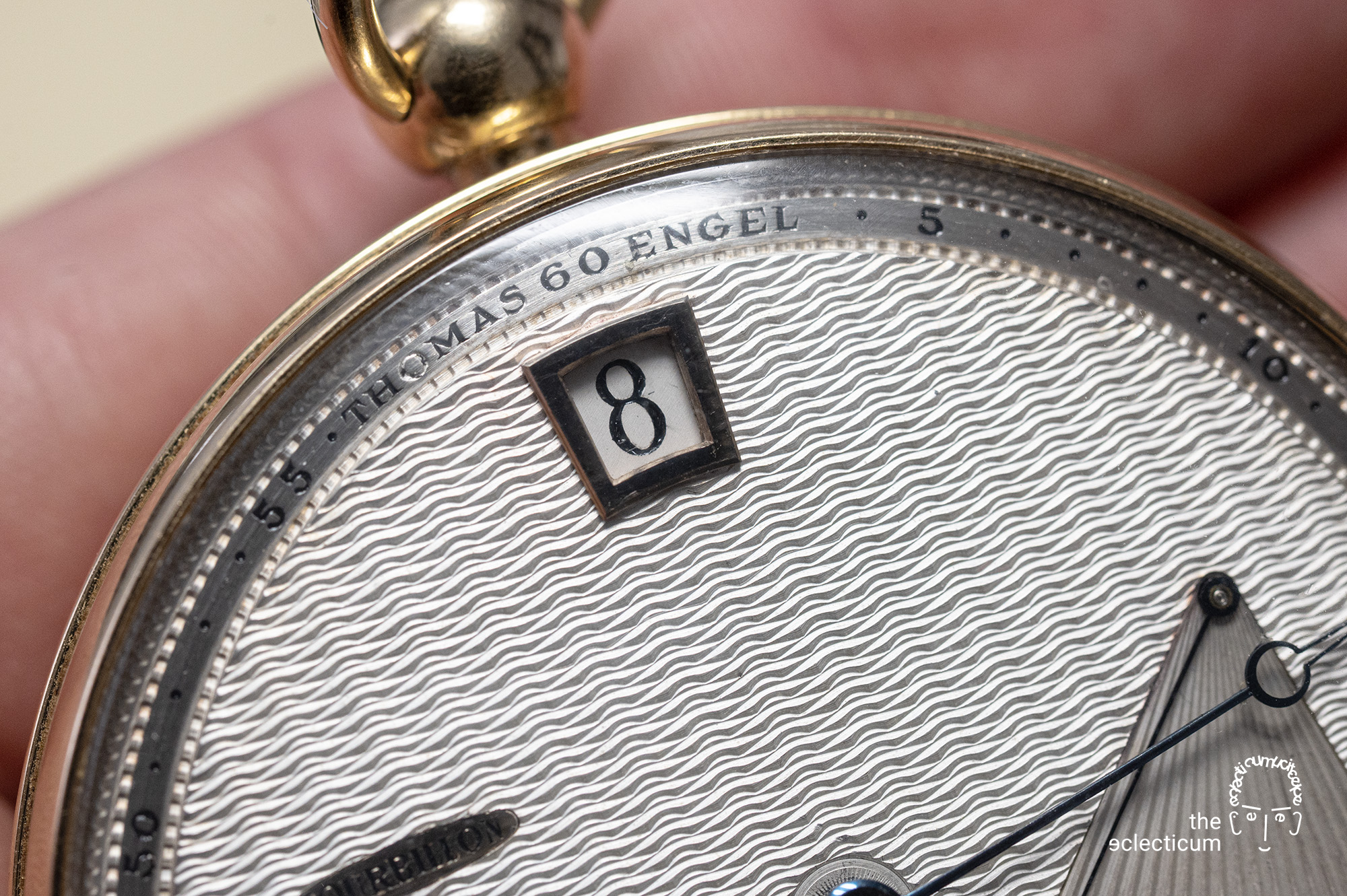
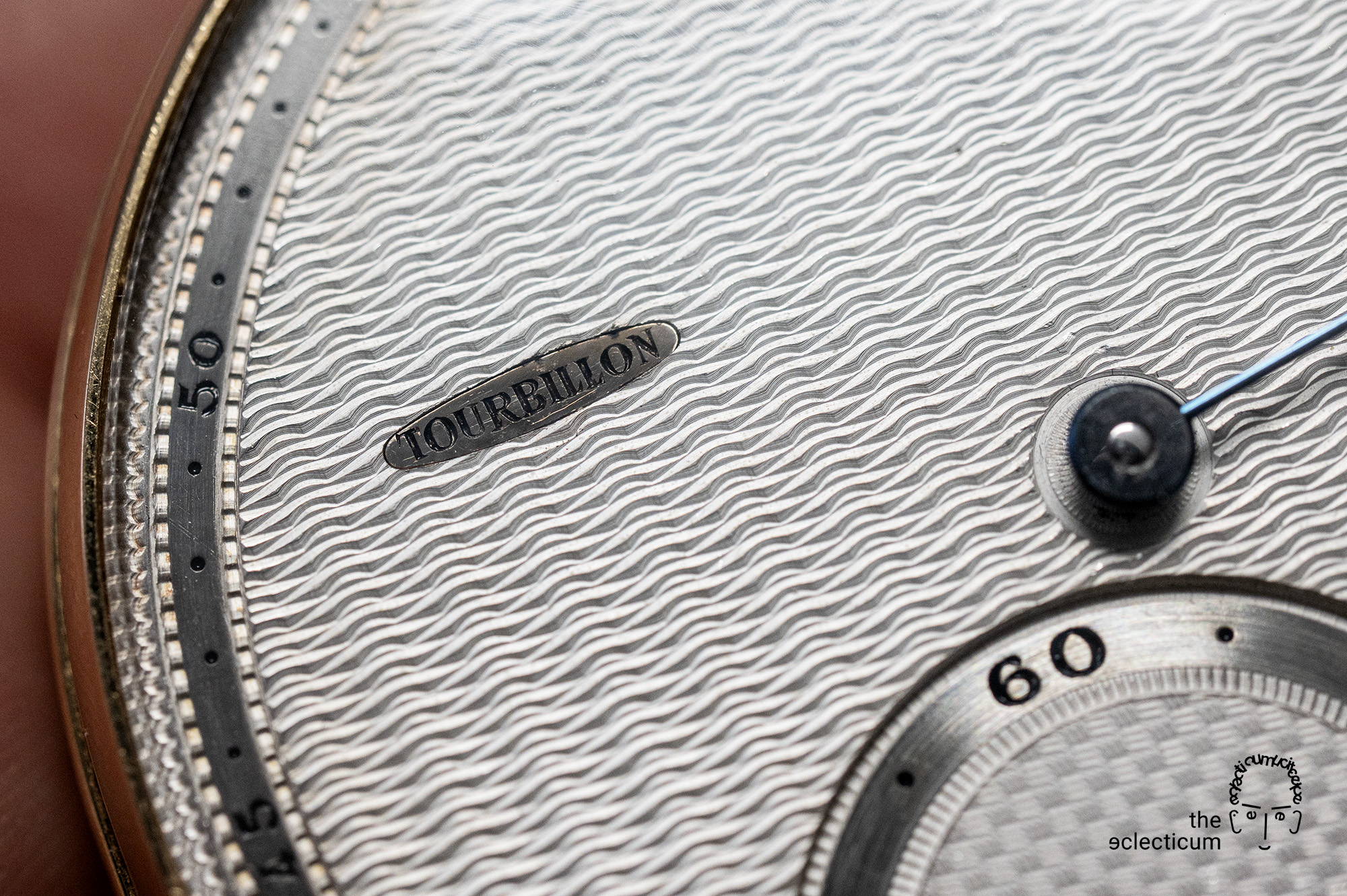
If you zoom in close enough, you’re realise the extreme care and precision of the engine-turned tracks (you can even detect the tool’s traces!), the precise inlays of the auxiliary dials as well as even the positioning feet of the seconds dial (or is this even the dial side tourbillon axis?):
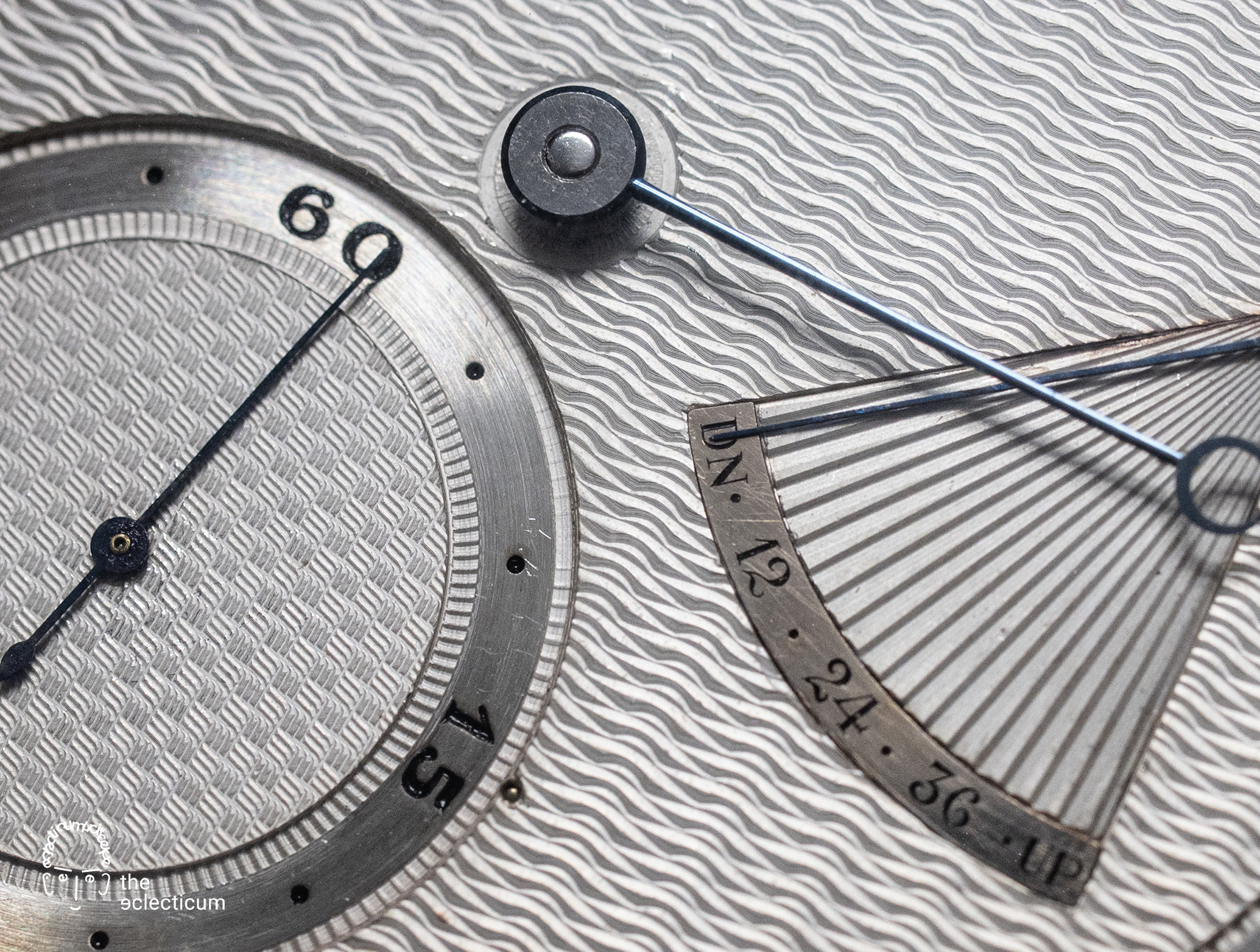
Note also the subtly engraved ring around the hour hand axis!
The hands are just marvelously fine works of art. Note the ‘poire’-shaped tip of the hour hand. You might be familiar of such hands by works of Kari Voutilainen or more recent Urban Jürgensen watches, but here the hand (by nature of a pocket watch) is a lot larger, but the details are equally finely made – amazing!
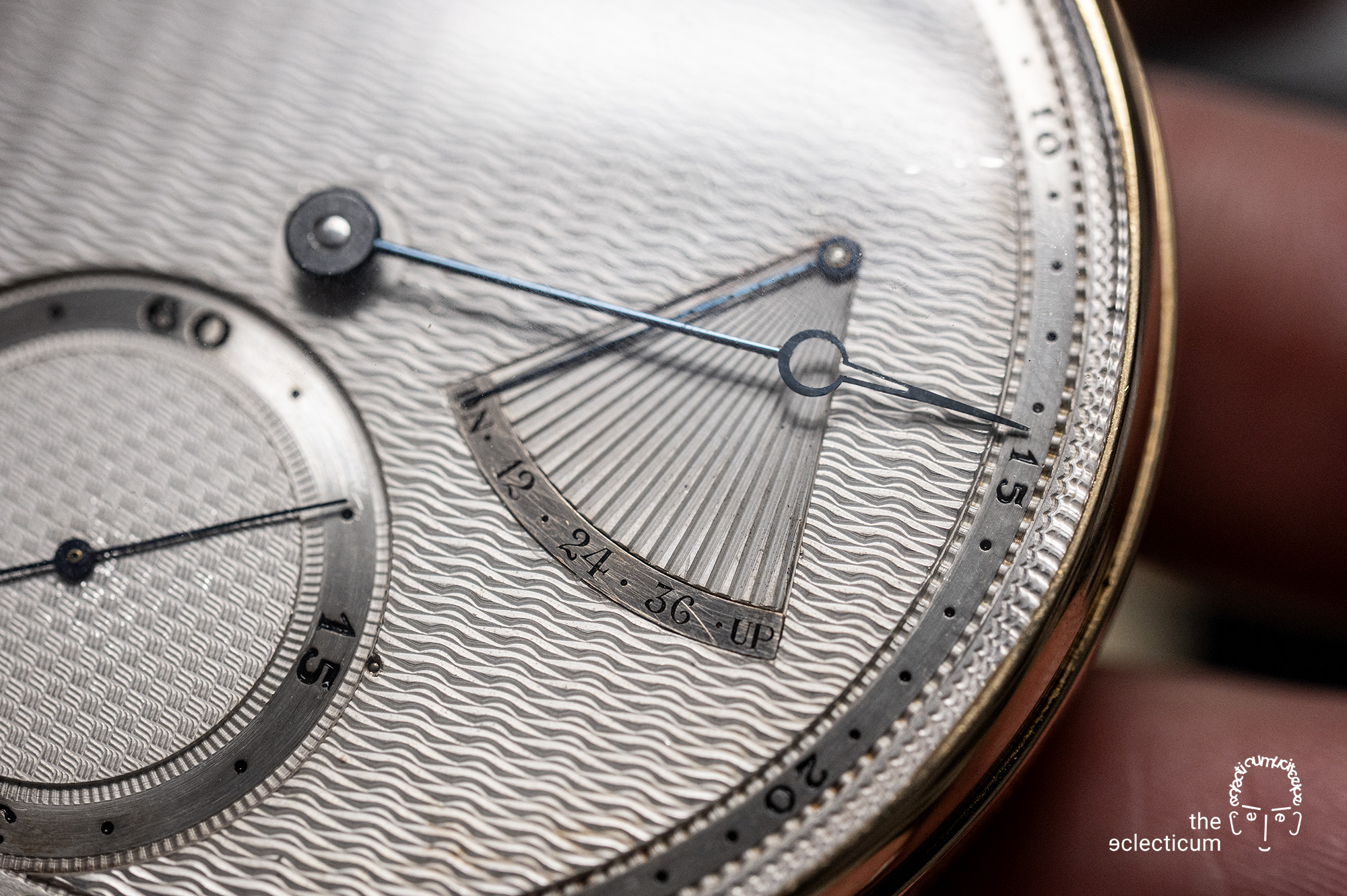
Swirling around freely, exacting way
Literature provides that Engel created 19 watches with tourbillon throughout his life. Most of them carried Engel’s signature light 3-arm tourbillon cage, beautifully mirror polished and equipped with a Guillaume compensation balance (Zenith was one of the first watch manufactures to adopt this type of balances, so no surprise here).
For these watches, Zenith agreed to supply a special version of its Cal. 5011 chronometer movemeent, called Cal. 5011T, an ebauche already with the round recess carved out for the tourbillon cage. The duo Daners/Engel then built their watches on this base.
However, this is different from the rest:
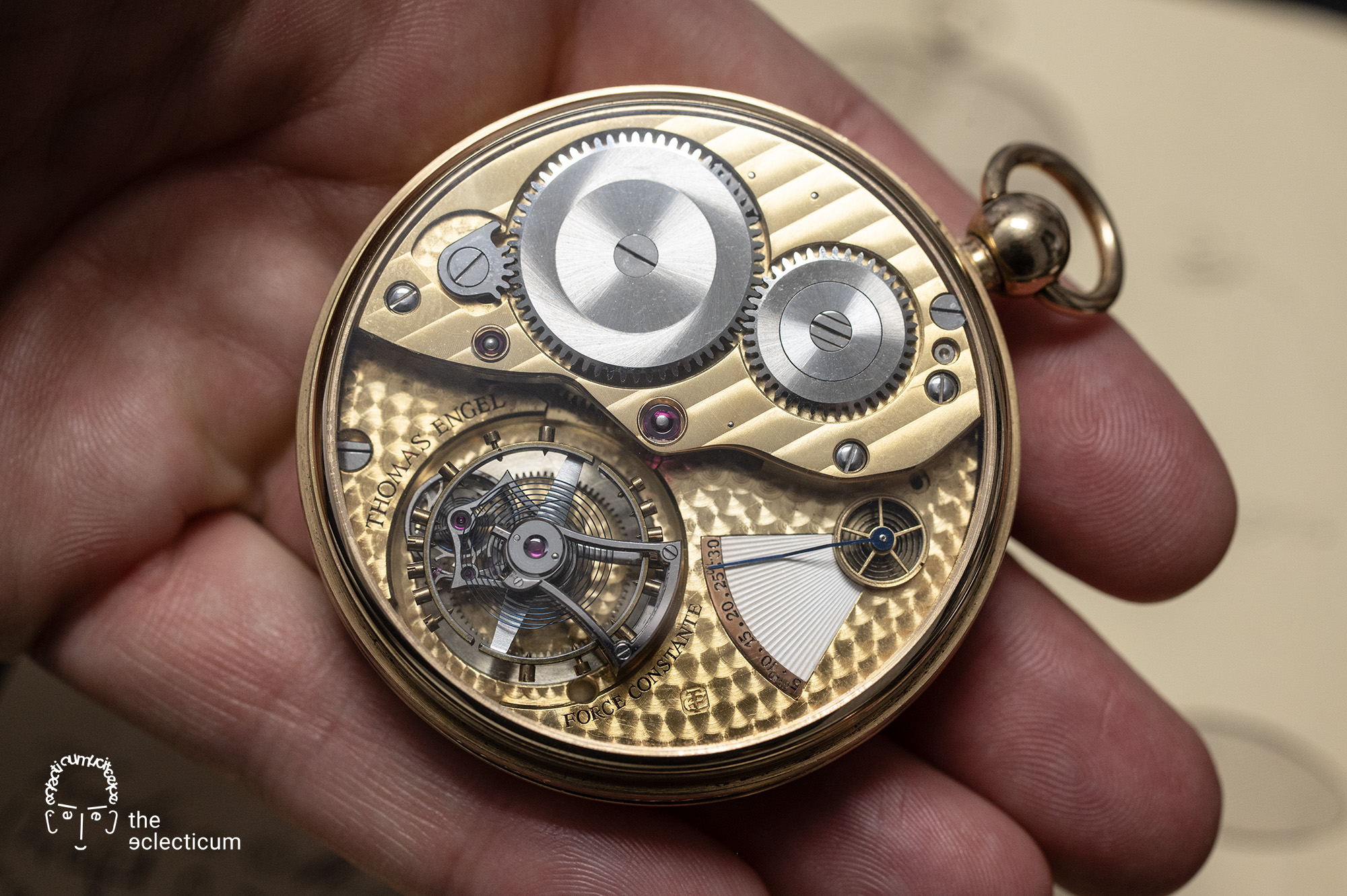
A flying tourbillon! A remontoir built into the tourbillon cage!
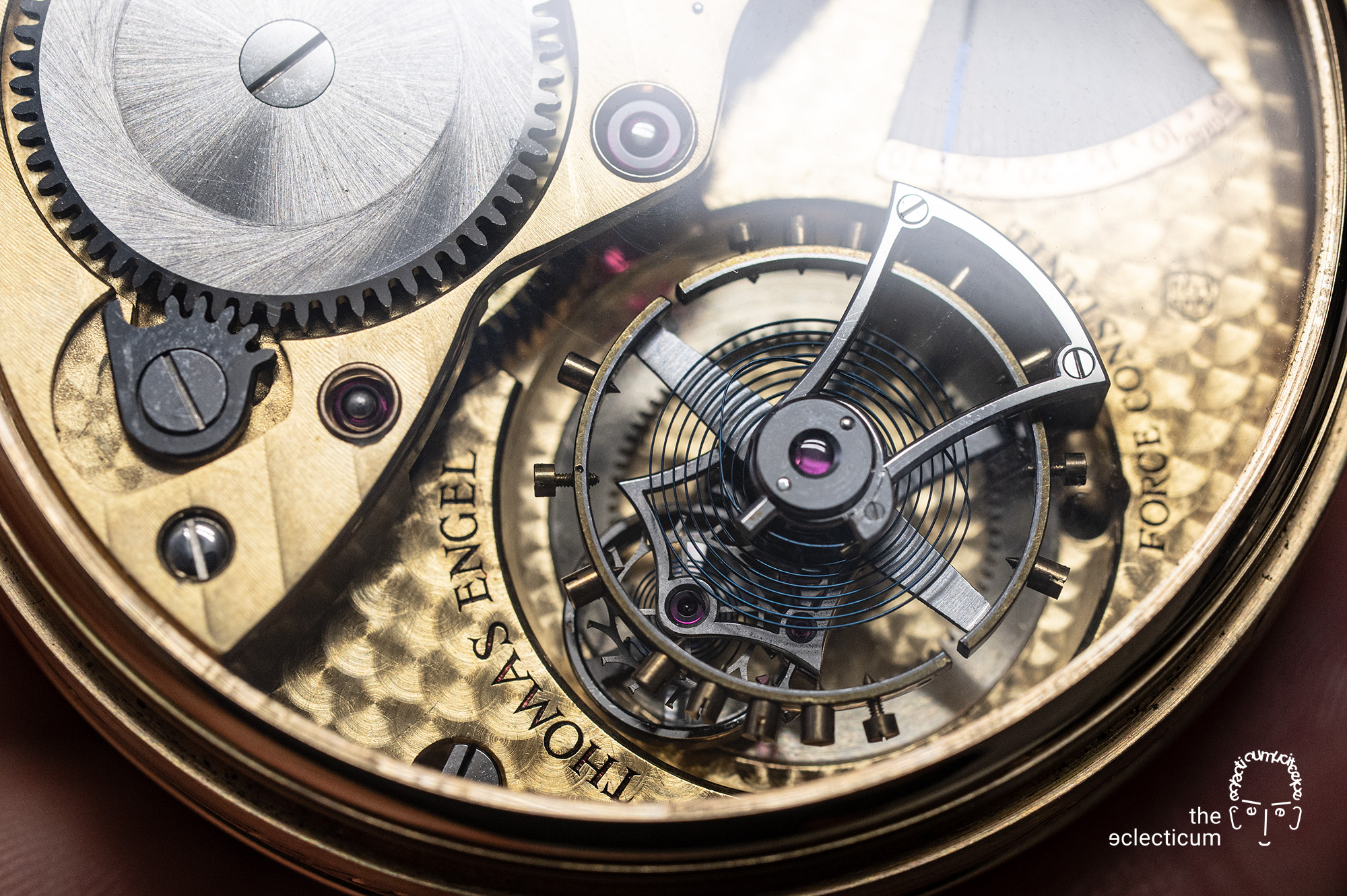 (Isn’t it just lovely how the light shines red through the large central jewel…)
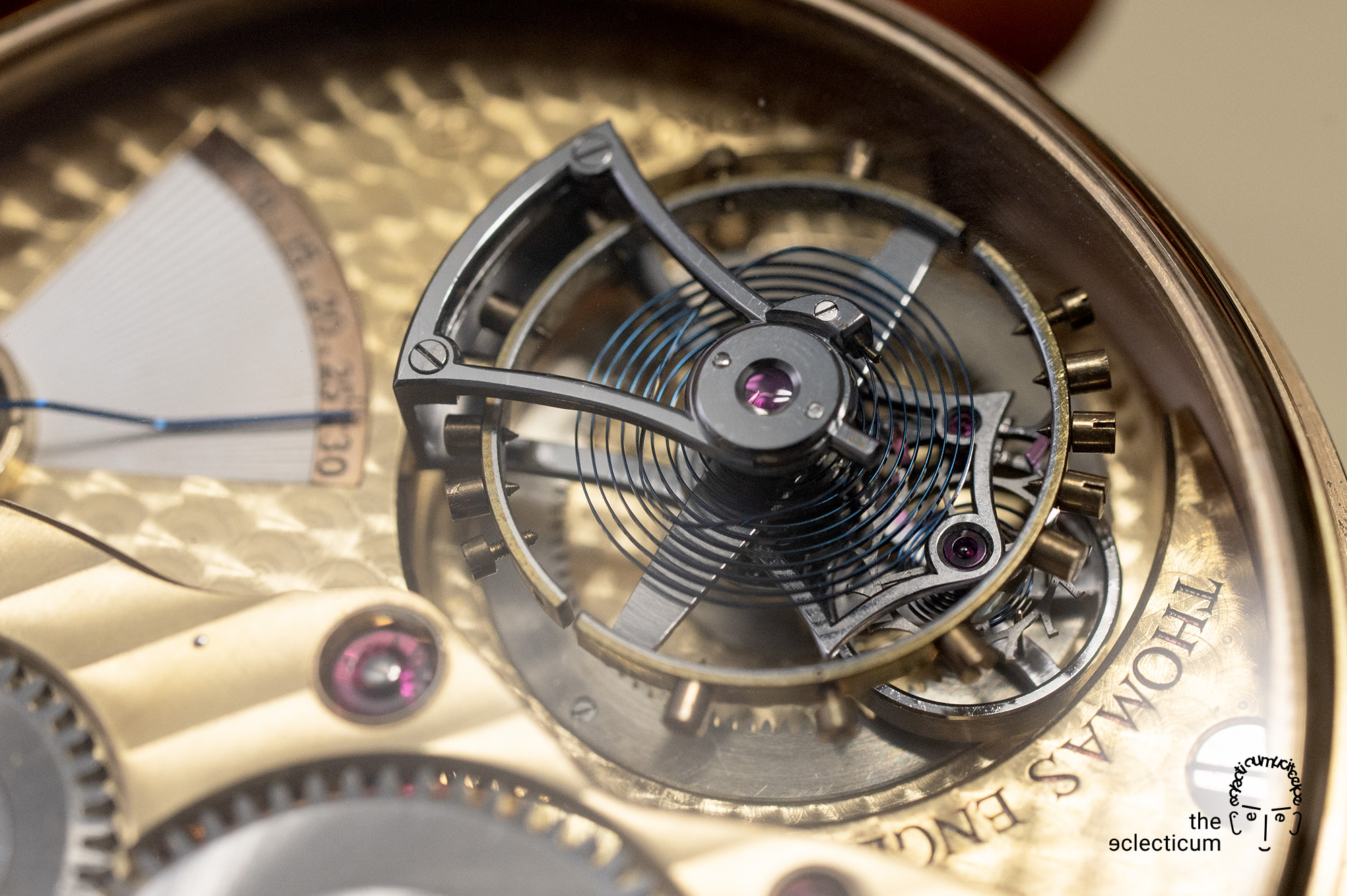
This is to my knowledge on of two Engel flying tourbillons, and the only one with a force constant mechanism built into the cage (to confirm this I would need to get hold of a copy of Manfred Rössler’s article on Engel’s watches). What a rare sight!
Engel, like Breguet, was obsessed with temperature and its influence on timekeeping, which is why many of his watches carried a thermometer, often on the movement side. This is no different. Note the finely inlaid dial and the wonderful bimetal temperature spring:
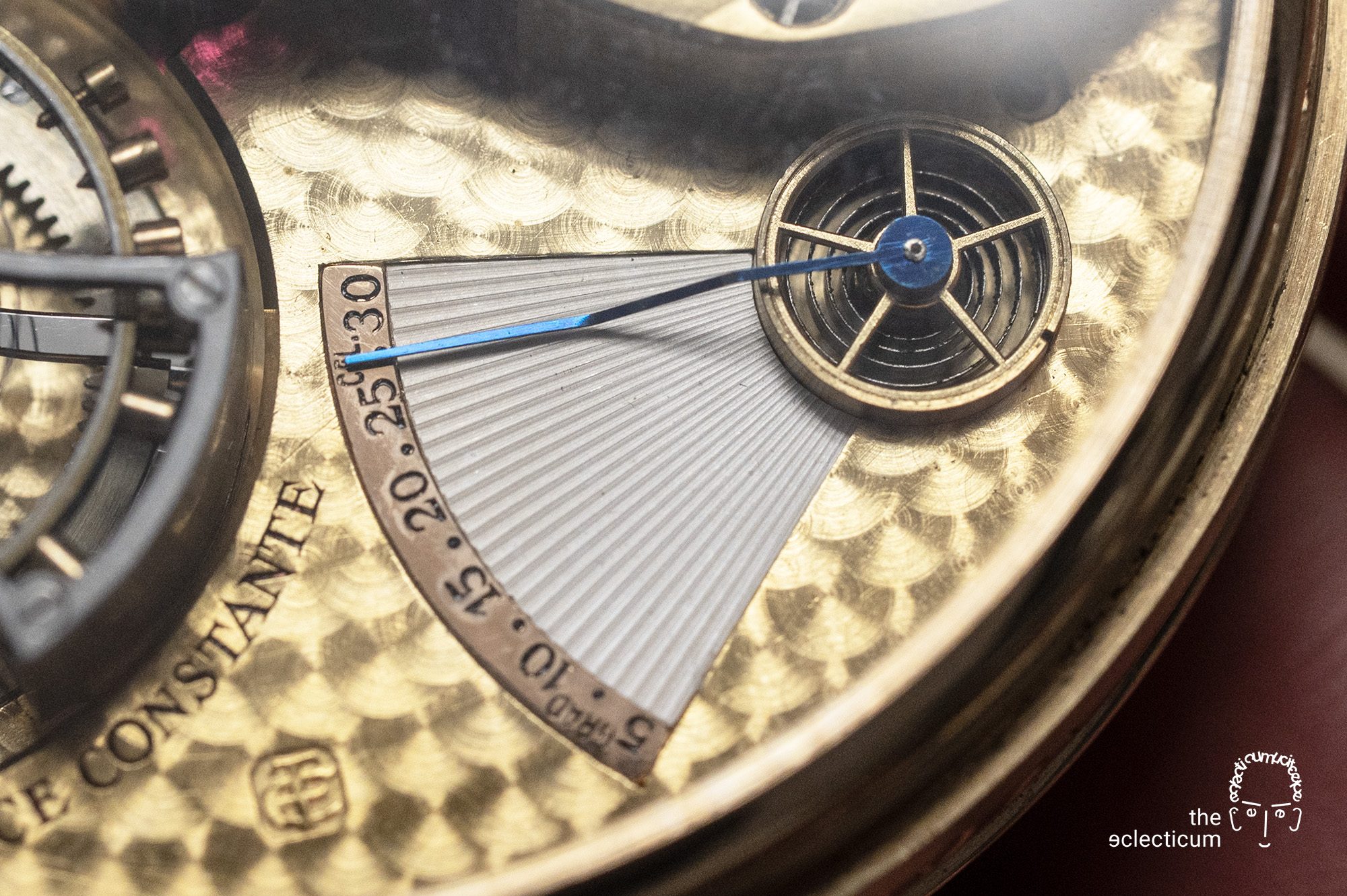
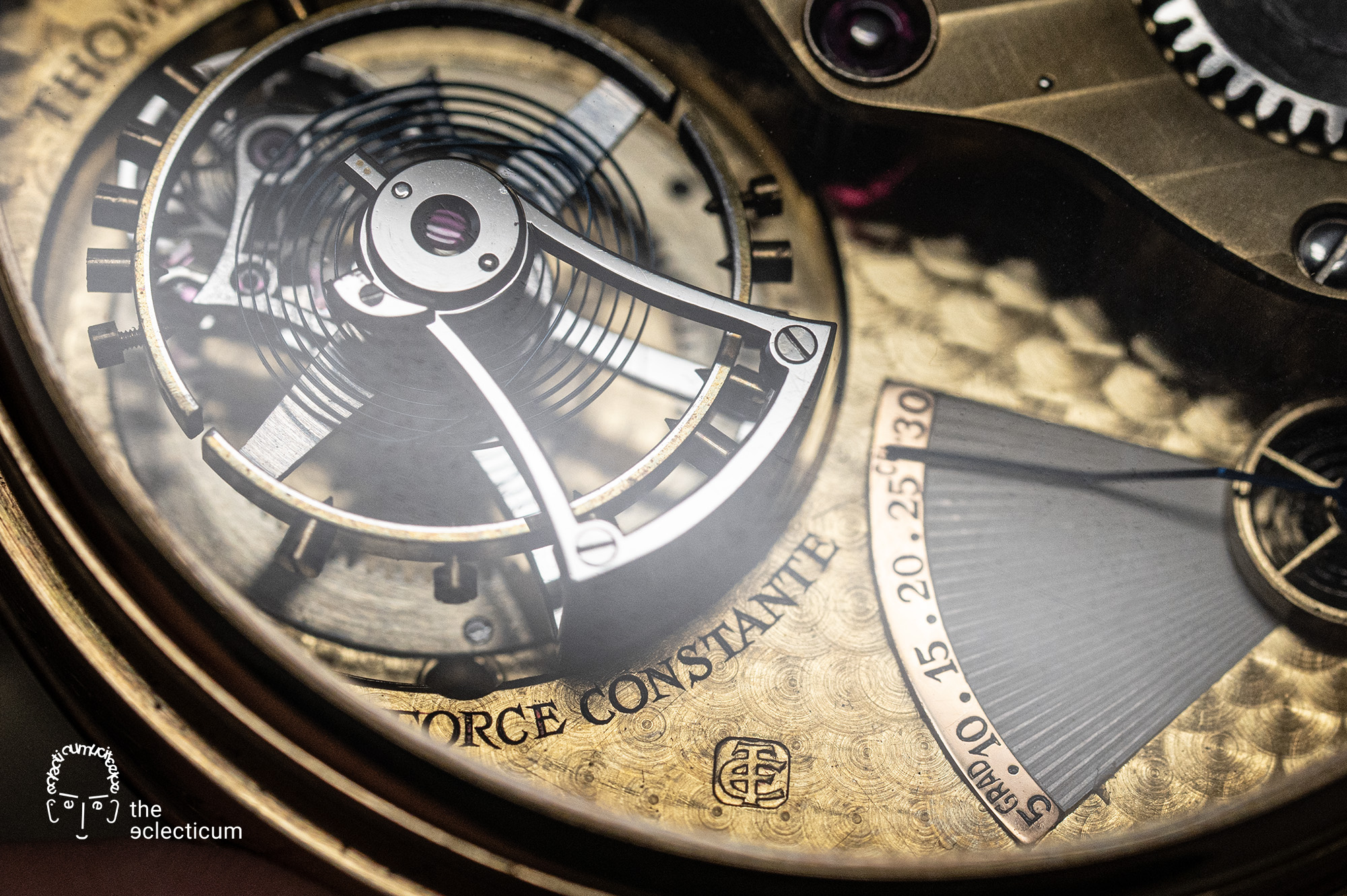
All of this again executed in the same artisanal style already seen with the dial work, and ‘crowned’ by Engel’s logo on the movement plate:
A case of controversy…
Finaly, let’s turn to the case: Thomas Engel crafted this from 18kt rose gold, with a diameter of 57mm, a screwed case back and glasses on both sides (supposedly mineral glass).
Owing to the Zenith base calibre, the pendant doubles as winding and time setting ‘crown’:
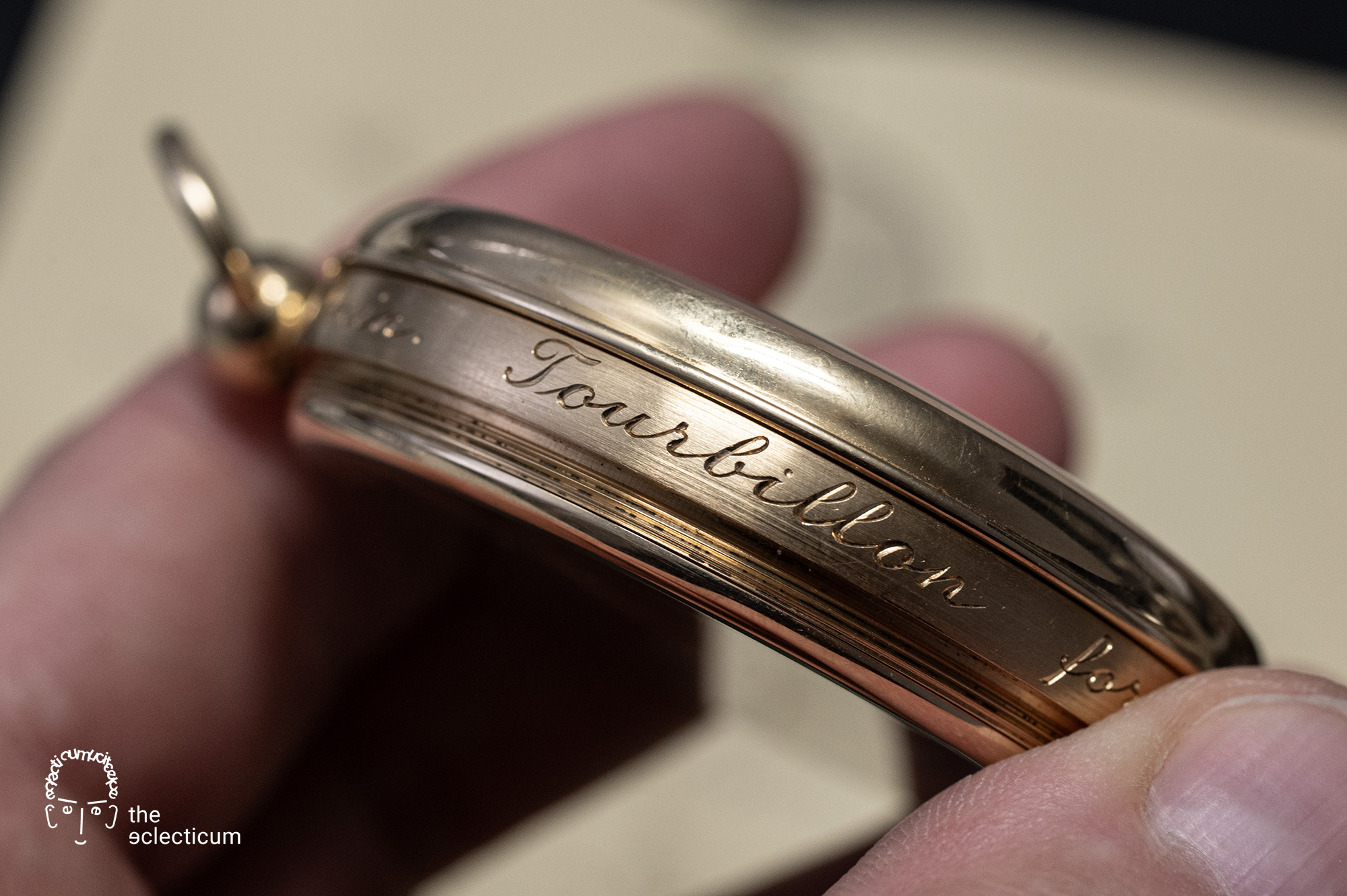
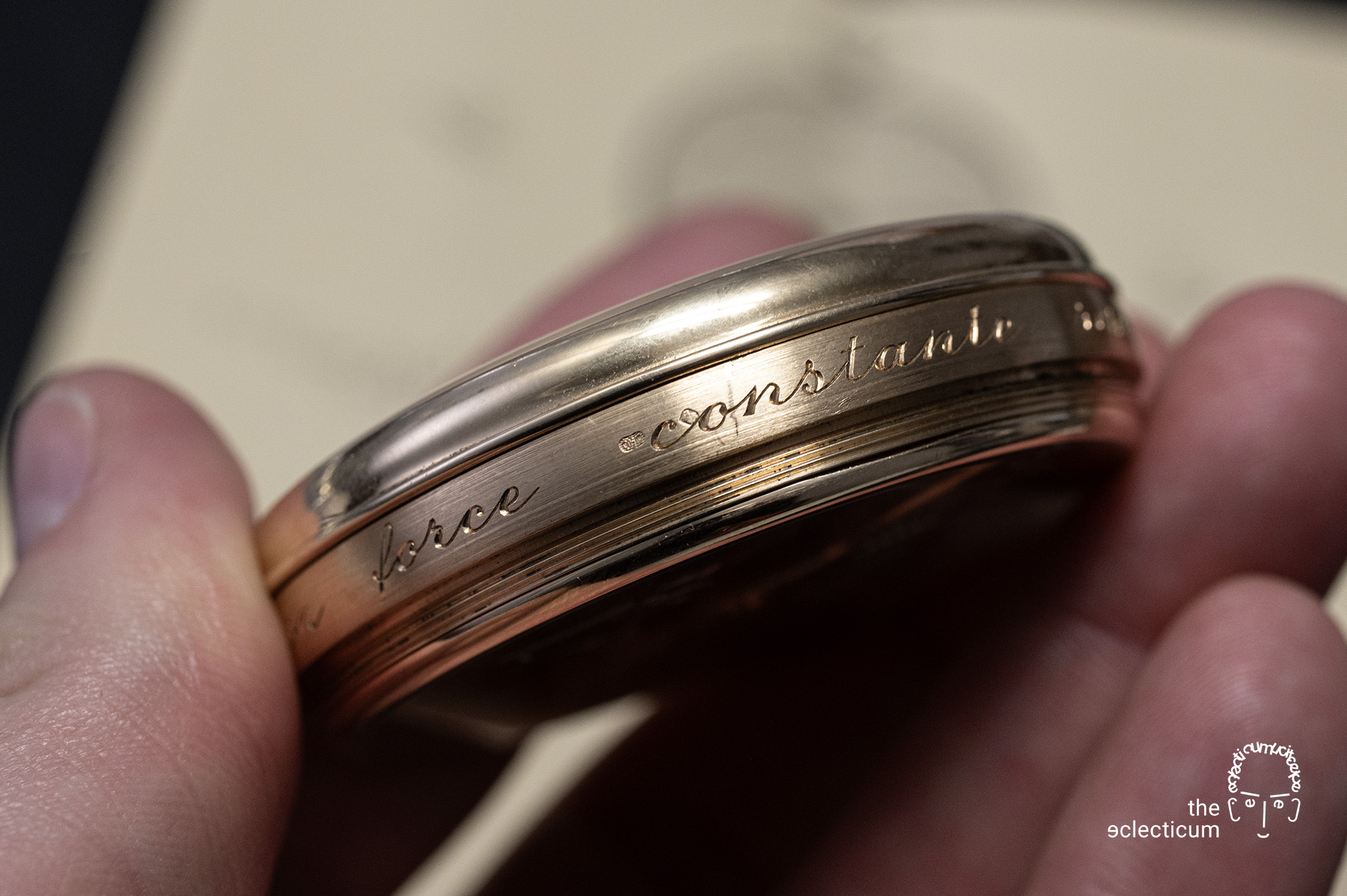
Further, Engel used to engrave a list of complications around the perimeter of the case band. And surely, here we read:
‘Tourbillon’
‘Force Constante’
‘Remontoir 0,2 sec’
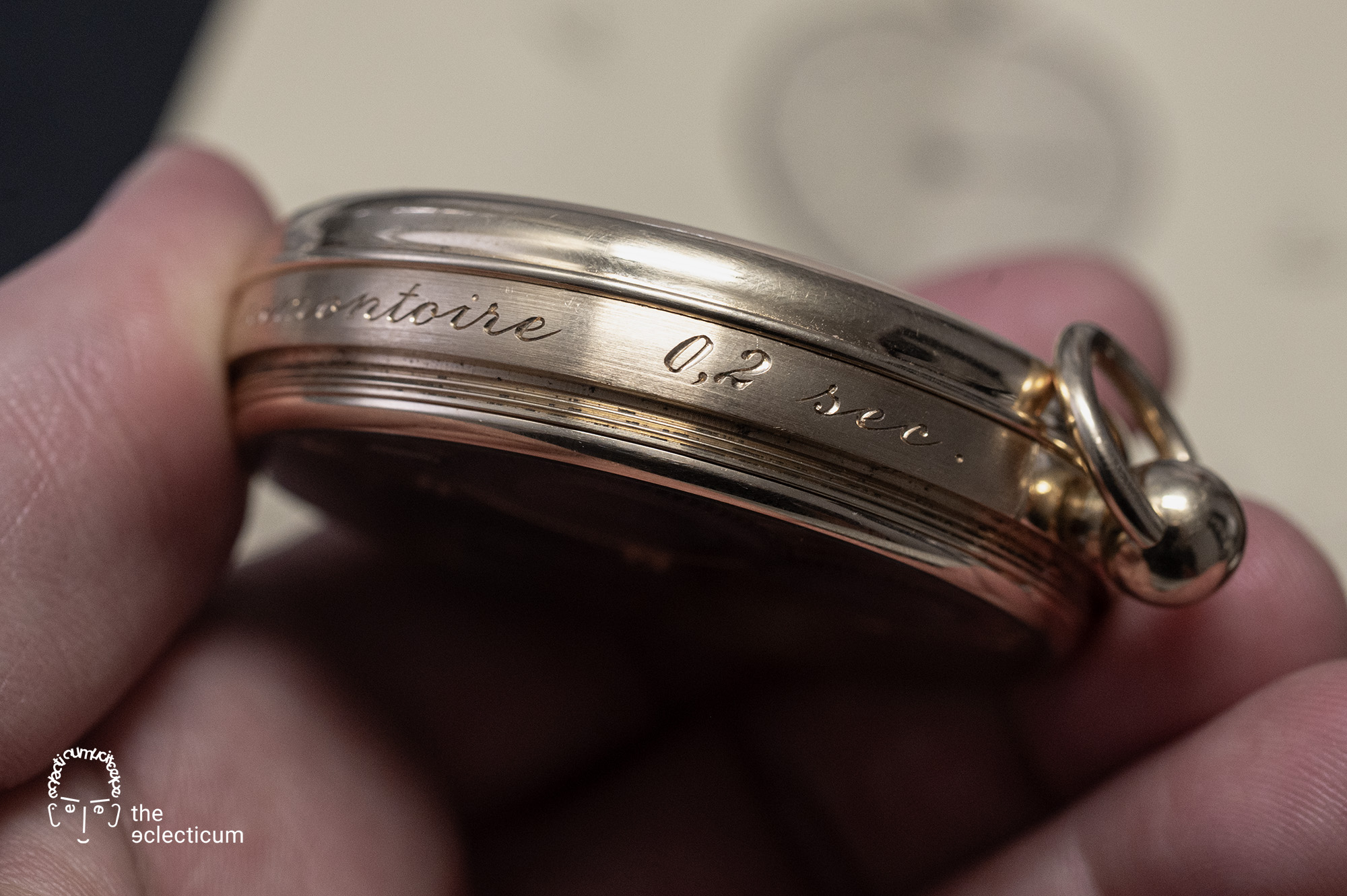
Finally, the Thomas Engel logo on the screwed caseback:
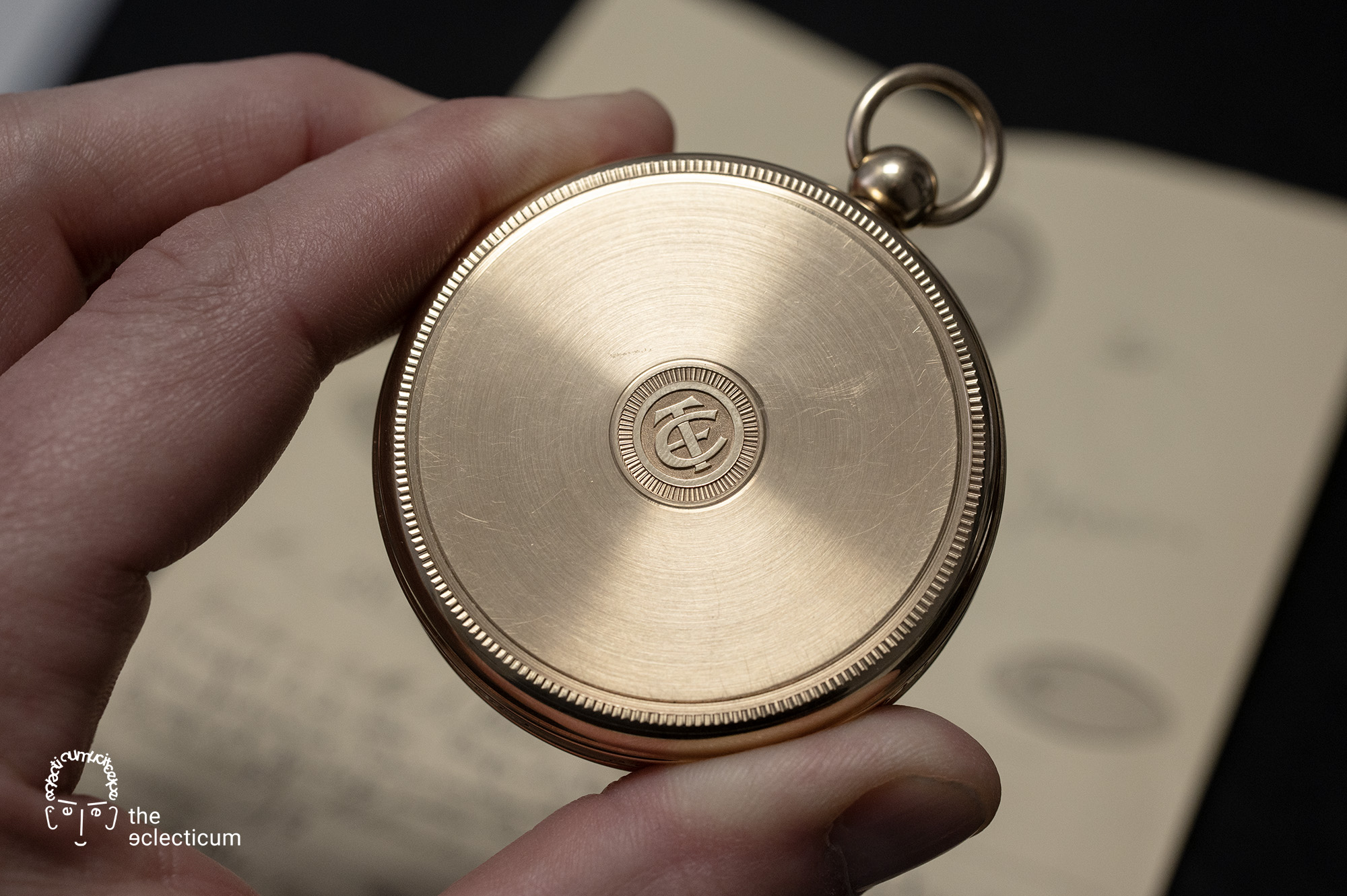
But where’s the ‘controversy’? Well, there is an anecdote: it appears like Thomas Engel and George Daniels (1926–2011) shared a kind of a ‘love/hate’ relationship. Both clearly recognised each other’s achievements and expertise and mutually supported each other at times (e.g., Engel provided Daniels with Breguet workshop notebooks Daniels otherwise would have no access to), but there was one trait of Engel’s personality Daniels objected too – some unhinged vanity:
Engel in 1974 purchased No. 7 of George Daniels’ early series of eight tourbillons. The watch was long believed to be made by Daniels for Engel since it carried the following engraving on the case band: ‘Made by George Daniels for Thomas Engel in mutual esteem of A.L. Breguet’.
However, it turned out later that Engel engraved the above himself, probably more as sign of appreciation rather than bad intent, but it sparked Daniels’ ire well enough that even two decades later he was still furious:
“I did not make the watch for him [Engel]. I wore the watch for nearly two years before I sold it to him. Of course I esteem Breguet, but that is not the reason I made the watch.” (George Daniels, referenced in the Ratskunk blog)
Well then… what would the world of horology be without ‘colourful’ personas?
This brings us to the last point…
Is this… ‘The One’? Some speculative fun!
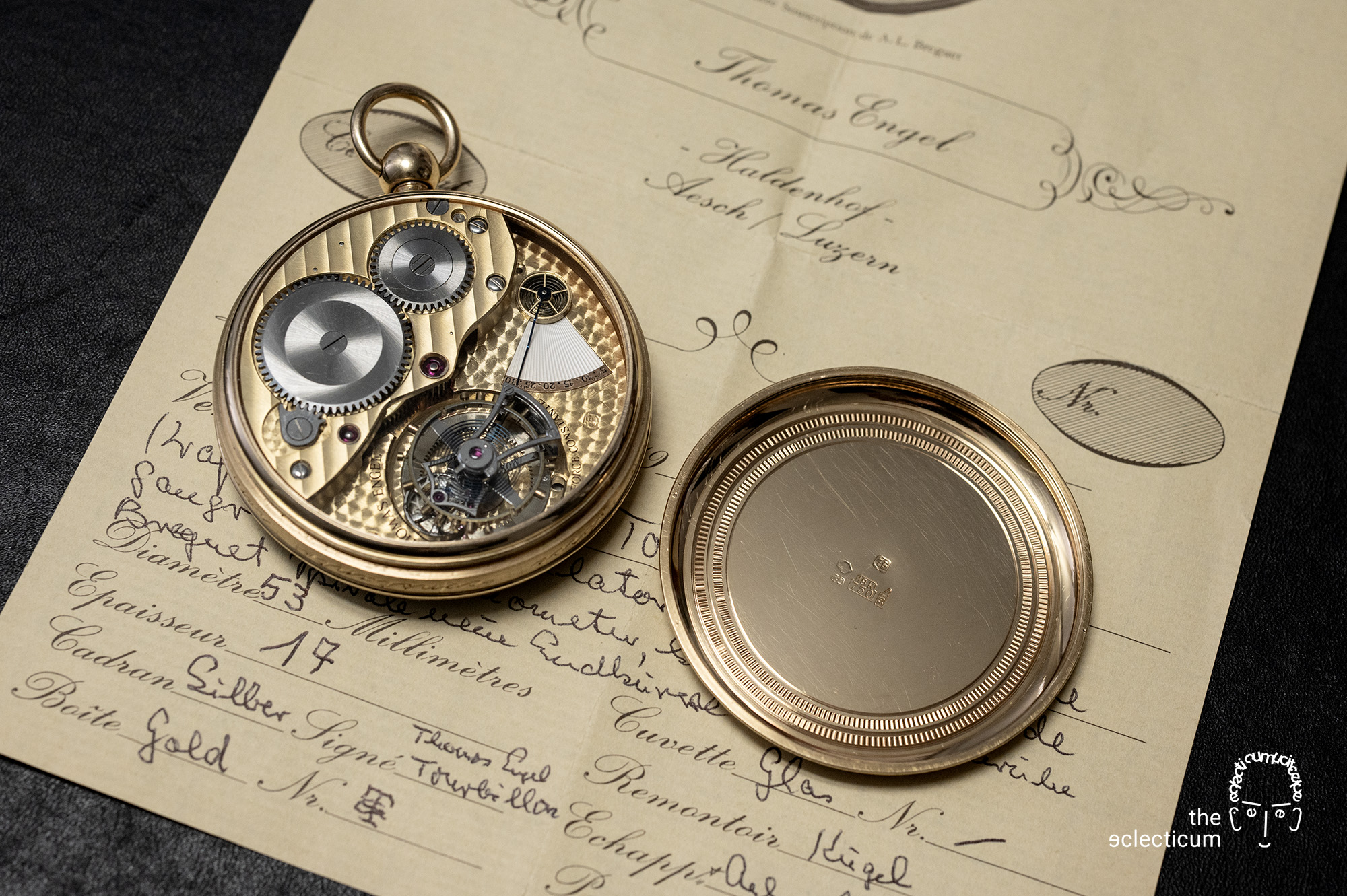
All Engel watches I am aware were presented in a Mahogony box with its signature elongated U-shaped lock (see opening image) and a small compartment for a spare mainspring and a spare set of hands (note: the hands were not the same those mounted on the watch. They were always heat-blued steel hands, often of different shape, even if the watch would originally carry solid gold hands. As if Engel would give a subtle hint that if you are not careful enough to preserve the original hands, you’re not lost but you shall be punished…).
The boxes also feature a latch to open a small tray in the cover where Engel would place his certificate:
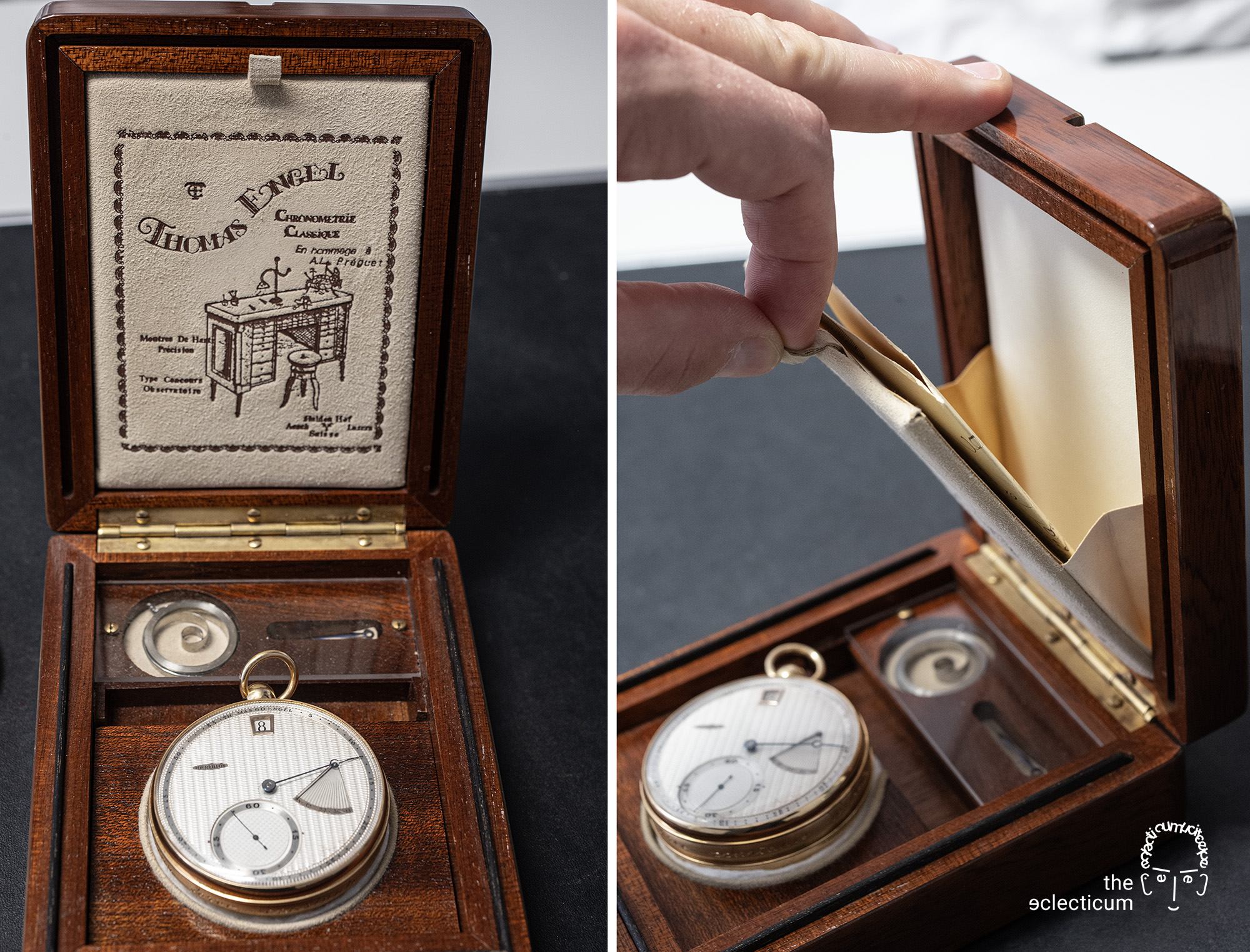
This is where it starts to get really curious…
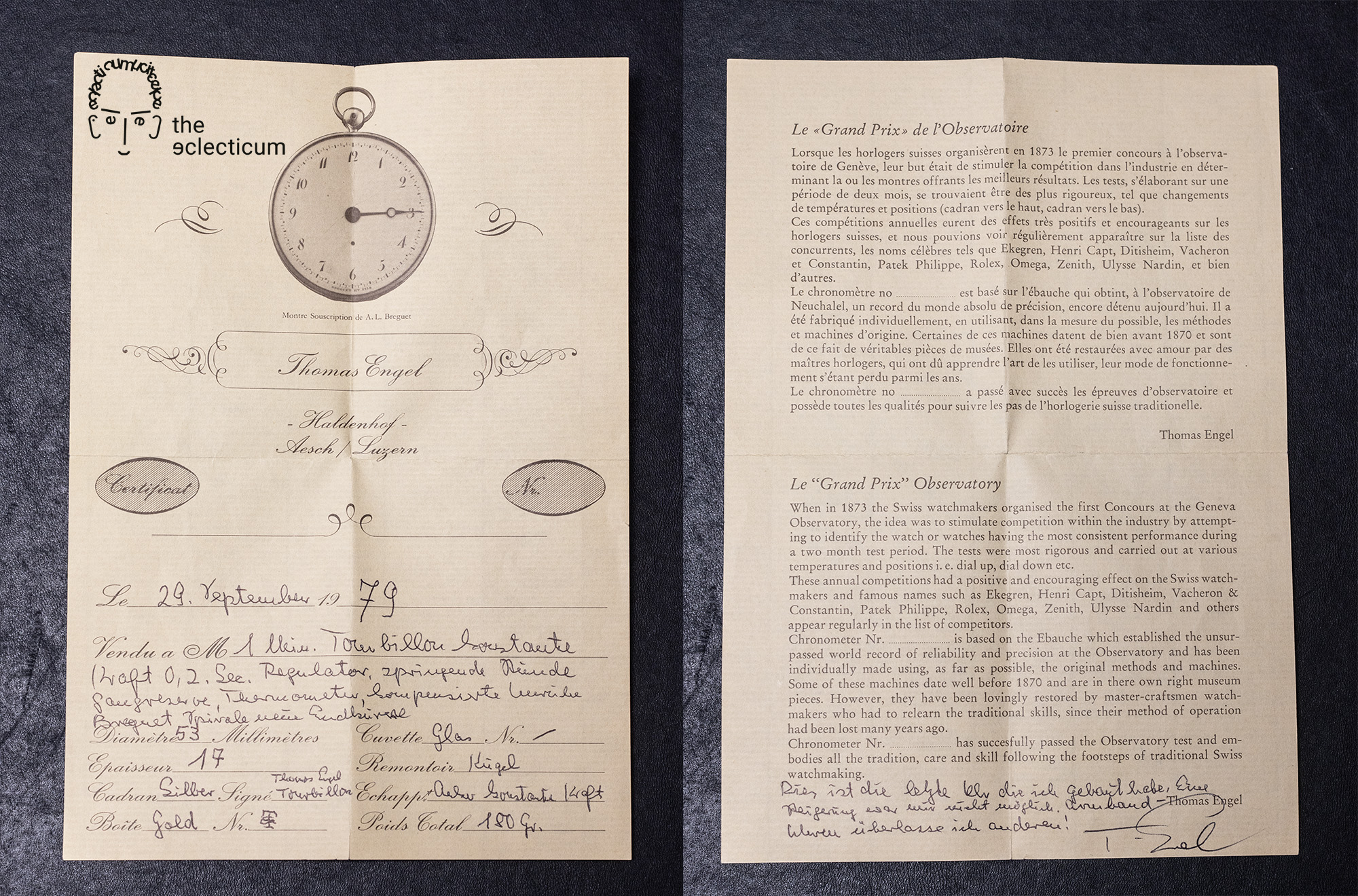
It’s obvious saying that Thomas Engel’s horological adventure was driven by a deep appreciation for the work of Abraham Louis Breguet, Engel stated that himself many times. Not only did he apply the same construction and design principles like his great role model, but he also focussed on similar complications, and he went as far as to present and describe his watches in a quite ‘Breguet-esque’ style.
For comparison, here is an original Breguet certificate:
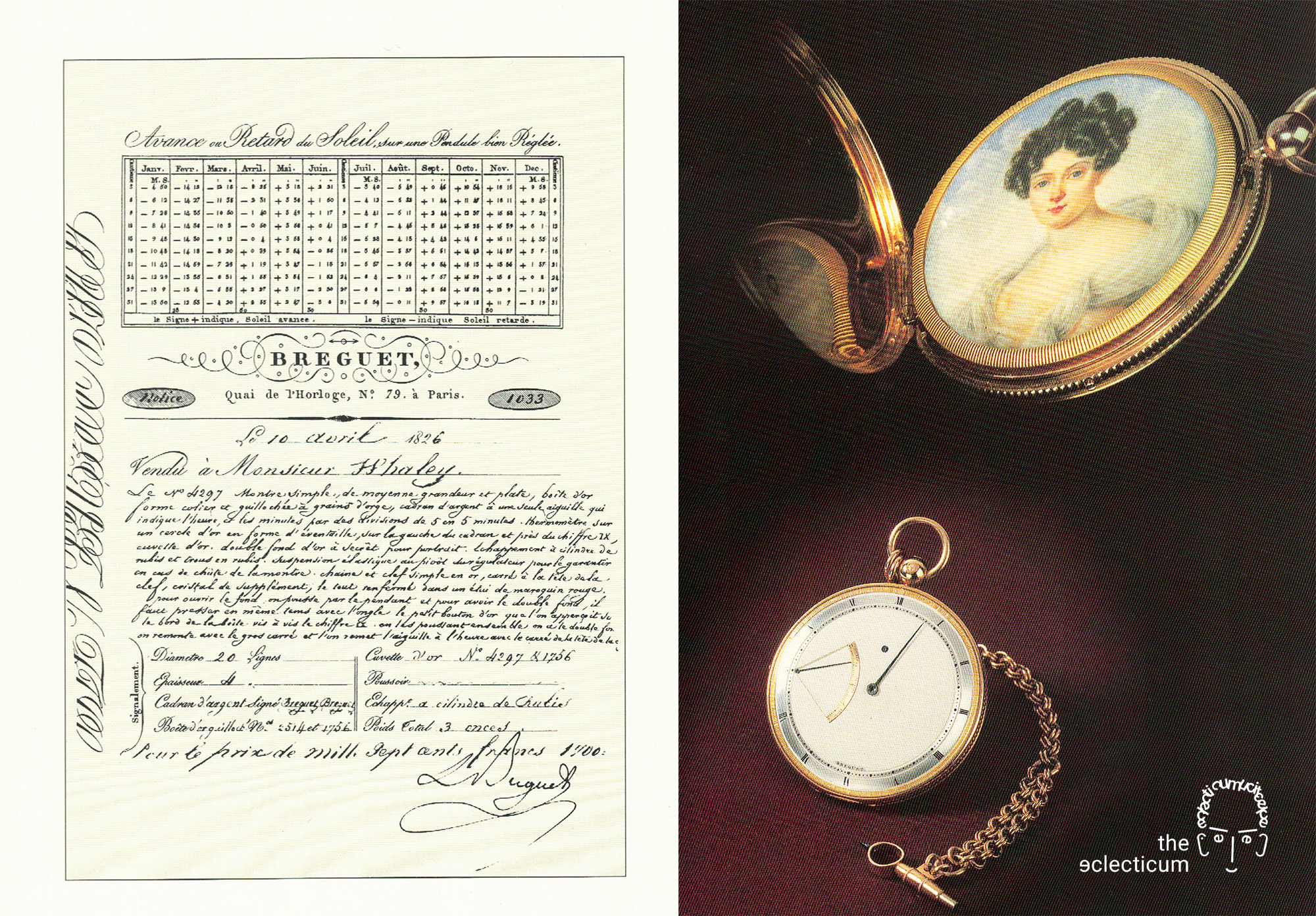
(Breguet’s certificate for watch No. 4297, and a photo of the watch itself, scanned from Thomas Engel’s book: ‘A. L. Breguet – Uhrmacher der Könige’ (1994), p. 110f.)
See the point?
If one now turns back to the watch’s certificate one will notice that neither the certificate nor the watch itself carries individual numbers, which is surprising given Engel’s noted scientific approach to watchmaking.
According to the Dorotheum auction house, the watch was consigned by a ‘friend of Engel’ who claimed having obtained it as a personal gift from the man himself. That might explain the lack of a certificate number – Engel might have just wanted to have the watch properly described and nothing more.
The lack of a watch number is more puzzling, as Engel was known for attaching such individual number *) to each of his pieces. Yet this does not have one…
One can only speculate, and I really would like to make it plainly clear that all what I’ve written below is nothing more than some imagination gone wild!
The following paragraph from Ratskunk’s blog comes to mind:
“Thomas Engle (sic!) jump-hours tourbillons (circa 1979): [No. 000 (Jump-hour) & No. 4 (Jump-hour)]—both watches are listed as “Fotos Thomas Engel” (‘Thomas Engel: Taschenuhr-Chronometer Im Stile Breguets’ by Manfred Rössler; in: Klassik-Uhren, Ebner Verlag. Issue 6/2011 p. 26–43). By appearances excepting one watch has a silver dial and the other gold the watches are more-or-less similar in design and function: Zenith ébauche, one-minute tourbillon, bimetallic thermometer, circa 1979: the author was unable to locate any auction appearances of the two watches.”
It appears that Engel made two jumping hour tourbillons in his life (I assume this refers to ‘digitally jumping’ as I seem to be certain he also made at least one jumping hour tourbillon with a conventional hour hand), all of them completed in 1979. The images Ratskunk listed point to the one being very similar (if not identical) to this very one in this article. None of them, so far, seem to have featured in auctions, and the only image available is the one in Manfred Rössler’s article in Klassik Uhren – an image provided by Thomas Engel himself.
Let’s have a close look at the certificate, this time of the flip side:
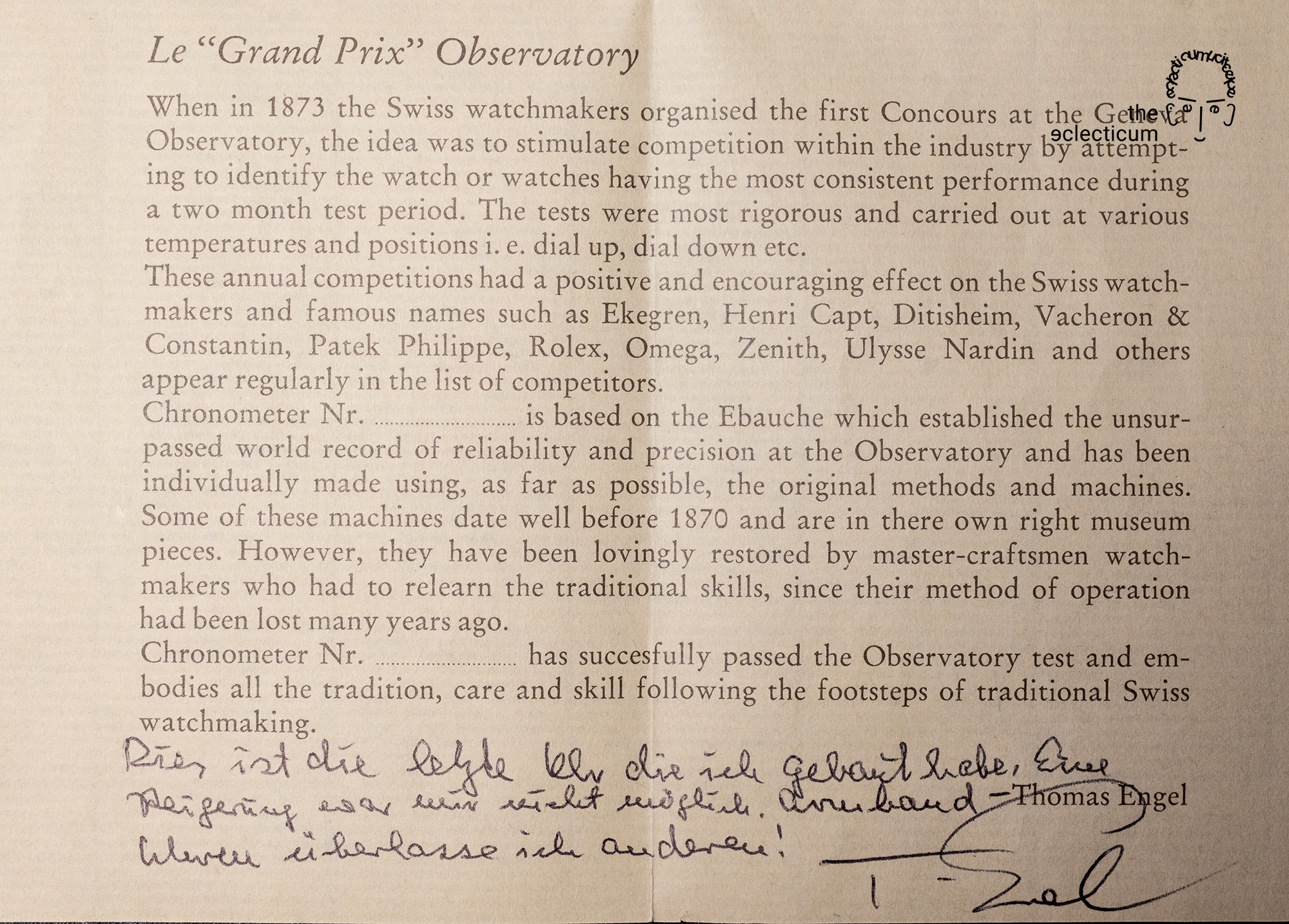
Engel notes:
“Dies ist die letzte Uhr die ich gebaut habe. Eine Steigerung war mir nicht möglich. Armbanduhren überlasse ich anderen!“
(‚This is the last watch that I made. Any improvement is not possible for me. I’ll leave wristwatches to others!’)
Clearly, this was not the last watch Engel made, by far not. In fact, in 1979 Engel was only in the last legs of his watchmaker’s apprenticeship with Richard Daners (Engel’s watchmaker certificate dates from 1979…).
Now let’s summarise:
- Neither the watch nor the accompanying certificate carries an individual number
- Literature mentions a jumping hour tourbillon ‘000’ (which could translate into ‘not numbered’ as this info came from Engel himself)
- The watch has a rare flying tourbillon
- Even rarer, it has a remontoir constant force built into the tourbillon cage
- The watch has a digital jumping hour indication
- The watch does not seem to have been subjected to chronometer testing
- The watch was made at the end of Engel’s watchmaking training
- Engel state this watch represents ‘the best he can do’
- The watch was never sold but gifted to a friend
What can we make of this?
Again, the following is pure speculation. What if Engel never really was happy with the flying tourbillon/remontoir construction, probably because of its chronometric performance? Given how much emphasis Engel put on this it would well explain (i) why this piece was not entered into observatory testing like his other watches and (ii) why it was never sold.
But how this this tally with his note that ‘this is the last watch that I made. Any improvement is not possible for me’?
I suggest the question is ‘what does this refer to’? Engel was clearly only at the very start of his watchmaking path. He might have had the ambition to embark onto more exotic tourbillon constructions and might have realised that there’s a limit of what he can do. So above sentiment might refer to such rare tourbillons, or specifically to flying ones with built-in remontoirs.
He also might have written this in an ad hoc moment of frustration and might have meant this as absolute as it reads.
It could also be – that this piece was his ‘school watch’ and he was quite satisfied (hence the note has to be read as sign of achievement, not of limitation) and that he had found his vocation (this explains the last part). It that case, ‘the last watch‘ might plainly translate into ‘the most recent one’.
A quick check with the Rössler article reveals that number ‘000’ indeed is listed with a 0,2min remontoir – bingo, I think, the watch here is this elusve watch which until now was believed to be still in the hand of the Engel family!
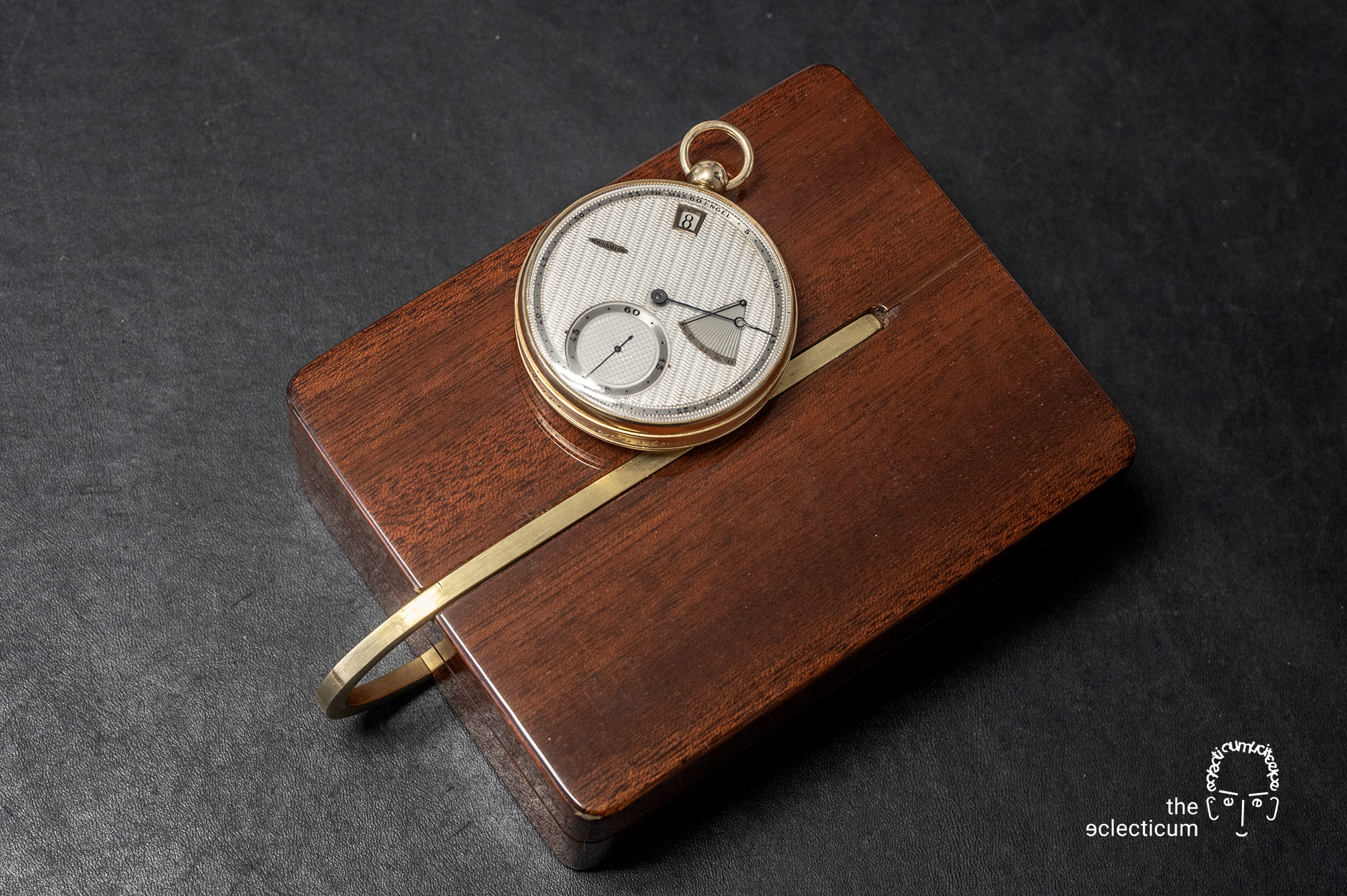
One is left speechless by the concept and execution of this piece, stunned by the personality of its creator (and his resourcefulness and stamina) and intrigued about the mystery which comes with this watch.
I can only encourage every passionate collector to grasp any chance to hold such a magnificent watch on one’s hands – I promise an experience that is not easily forgotten.
I would like to express my gratitude to:
- Mr. Günter Eichberger and Mr. Thomas Schmolek from Dorotheum auction house for allowing me to handle this watch and for providing most valuable background info
- ‘Ratskunk’ for providing valuable details and above all a copy of the Rössler article
Ornatus Mundi
P.S.: Above Thomas Engel Flying Tourbillon with Remontoir and Jumping Hours was auctioned at the Dorotheum Auction House Vienna on Friday, 22 May 2026 as Lot 409. With a hammer price of € 1,025,000.- it exceeded its high estimate of € 30,000 by a factor or 34x!
- Dorotheum VIE, 22 May 2026, Lot 409 (estimate: EUR 20,000 – EUR 30,000): https://www.dorotheum.com/en/l/10103995/
____________________
Literature:
- Complicated Collectors: Thomas Engel, a presentation of Thomas Engel’s life and his becoming of an expert Breguet collector and watchmaker, by Carlos Torres on the Watches by SJX blog (https://watchesbysjx.com/2025/10/thomas-engel-collector-profile-breguet.html)
- Never Mind the Bollocks…Here’s Thomas Engel, a comprehensive (and quite masochistic but still rewarding to read) compendium of Thomas Engel’s life and work by Ratskunk on his namesake blog (https://www.ratskunk.com/te/)
- Zenith Meets Breguet: The Chronometers Of Thomas Engel by John Chris at Omegaforums (https://omegaforums.net/threads/zenith-meets-breguet-the-chronometers-of-thomas-engel.8261/)
- Thomas Engel: Taschenuhr-Chronometer Im Stile Breguets by Manfred Rössler; in: Klassik-Uhren, Ebner Verlag. Issue 6/2011 p. 26–43
____________________
*) The system for watch numbering employed by Engel is a bit of mysterious. He used Roman and Arabic numbers intermixed, and gave same numbers more than once, albeit on watches featuring different complications.
